Select region and language
Close button
Booking and service information for the selected country and language will be applied.
paradise

A journey of history and nature through places to visit in Dien Bien

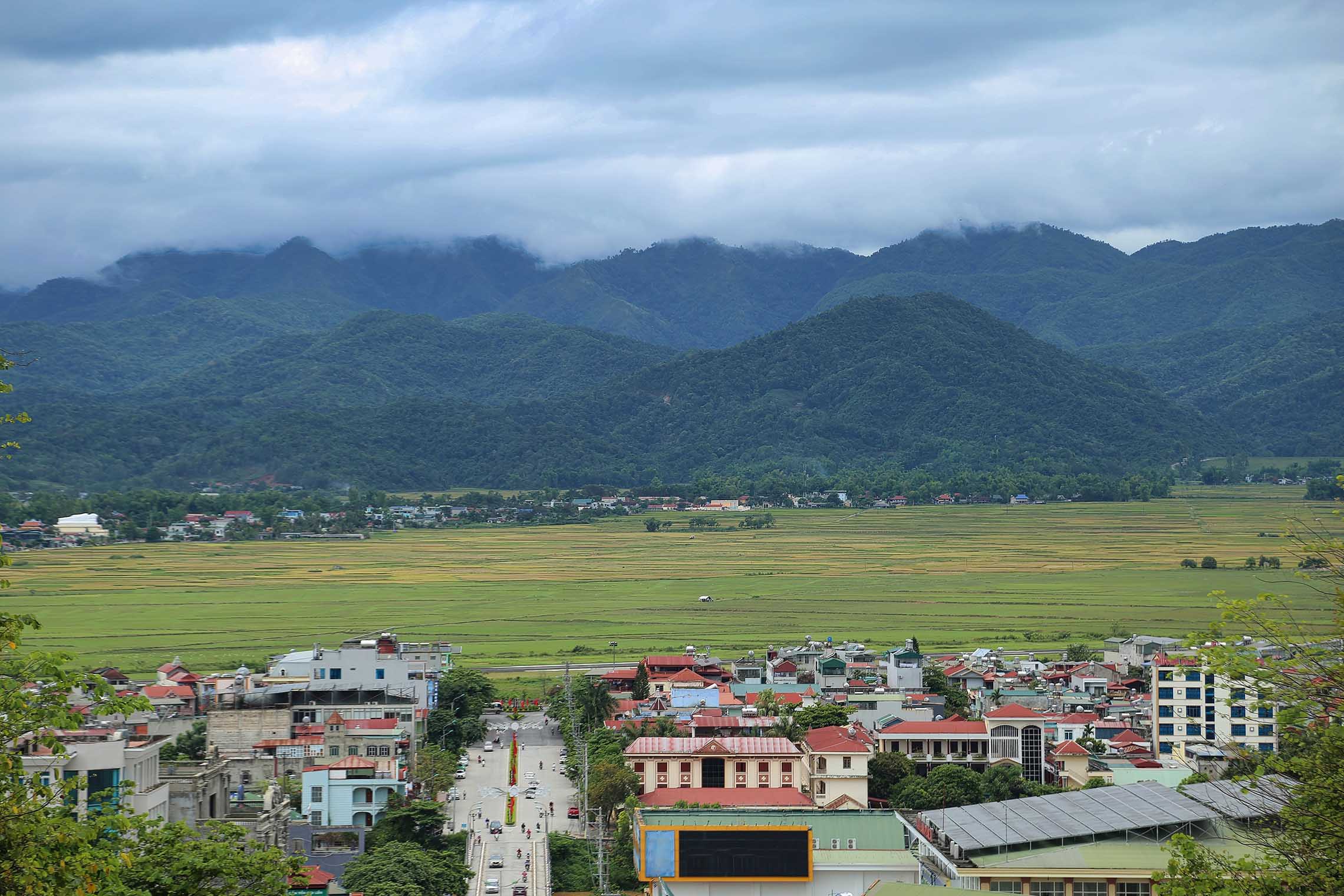
Dien Bien rises from the Muong Thanh Valley, where majestic mountains surround a landscape marked by one of the most important chapters in Vietnam’s history, while villages, forests and rice fields preserve the distinctive character of the Northwest. Mornings might begin at the Dien Bien Phu Battlefield, continue to A1 Hill and the De Castries Command Bunker, before leading into quieter valleys and villages where local traditions and everyday life remain closely connected to the land. The province brings together a proud history, dramatic mountain scenery and vibrant ethnic cultures, making the places to visit in Dien Bien an evocative journey through Vietnam’s past and the grandeur of its northern highlands.

Places to visit in Dien Bien where history meets the Northwest highlands

In Vietnam’s far northwest, the road into Dien Bien descends through mountain country before opening onto Muong Thanh Valley, with the Nam Rom River winding between rice fields and rugged peaks. The valley holds the memory of the Dien Bien Phu Campaign – culminating in the historic victory of May 7, 1954, celebrated across Vietnam as a triumph 'resounding across the five continents and shaking the globe' – yet its forests, caves, hot springs and high mountain passes create a journey of their own. Here, villages appear between the hills, rice fields stretch across the valley floor and everyday life continues beneath the same peaks that witnessed one of the country’s most decisive battles. The most compelling places to visit in Dien Bien follow this meeting of remembrance, remote scenery and the enduring life of the mountains.

Places to visit in Dien Bien – Where history still echoes

Dien Bien asks to be explored slowly, with mountain roads leading from one scene to another and traces of the past appearing alongside everyday highland life.

Muong Thanh Valley turns gold beneath the mountains

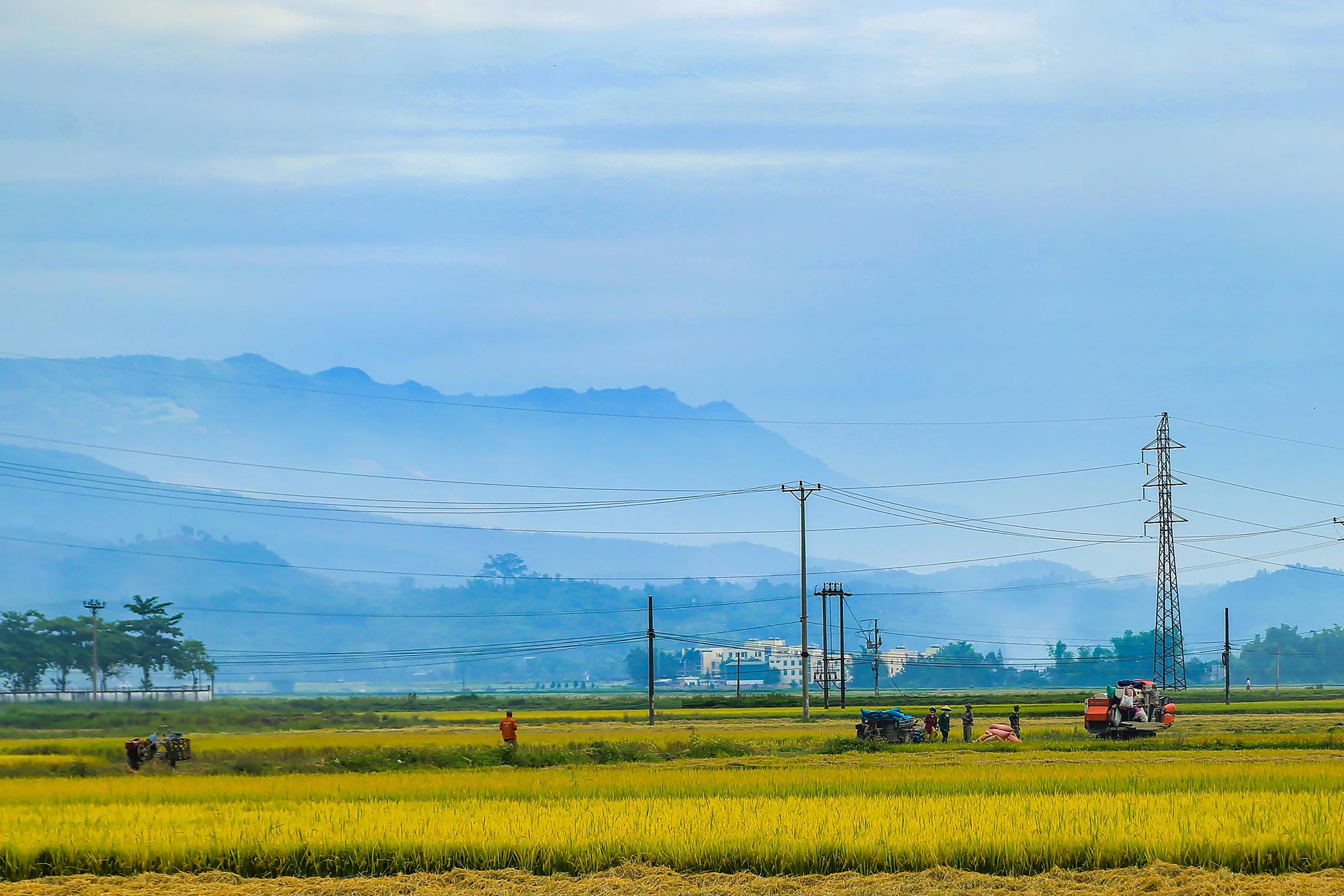
After kilometres of winding mountain roads, Muong Thanh Valley opens into the largest alluvial basin in Vietnam’s Northwest – celebrated in the traditional proverb 'First Thanh, second Lo, third Than, fourth Tac' and known in ancient Thai legend as Muong Then, the sacred 'Heavenly Land' – unfolding along the gentle Nam Rom River beneath successive layers of rugged peaks. The sudden breadth of the valley is breathtaking after the narrow roads and steep slopes behind, with fields stretching beneath the peaks until the horizon seems almost entirely enclosed by mountains.
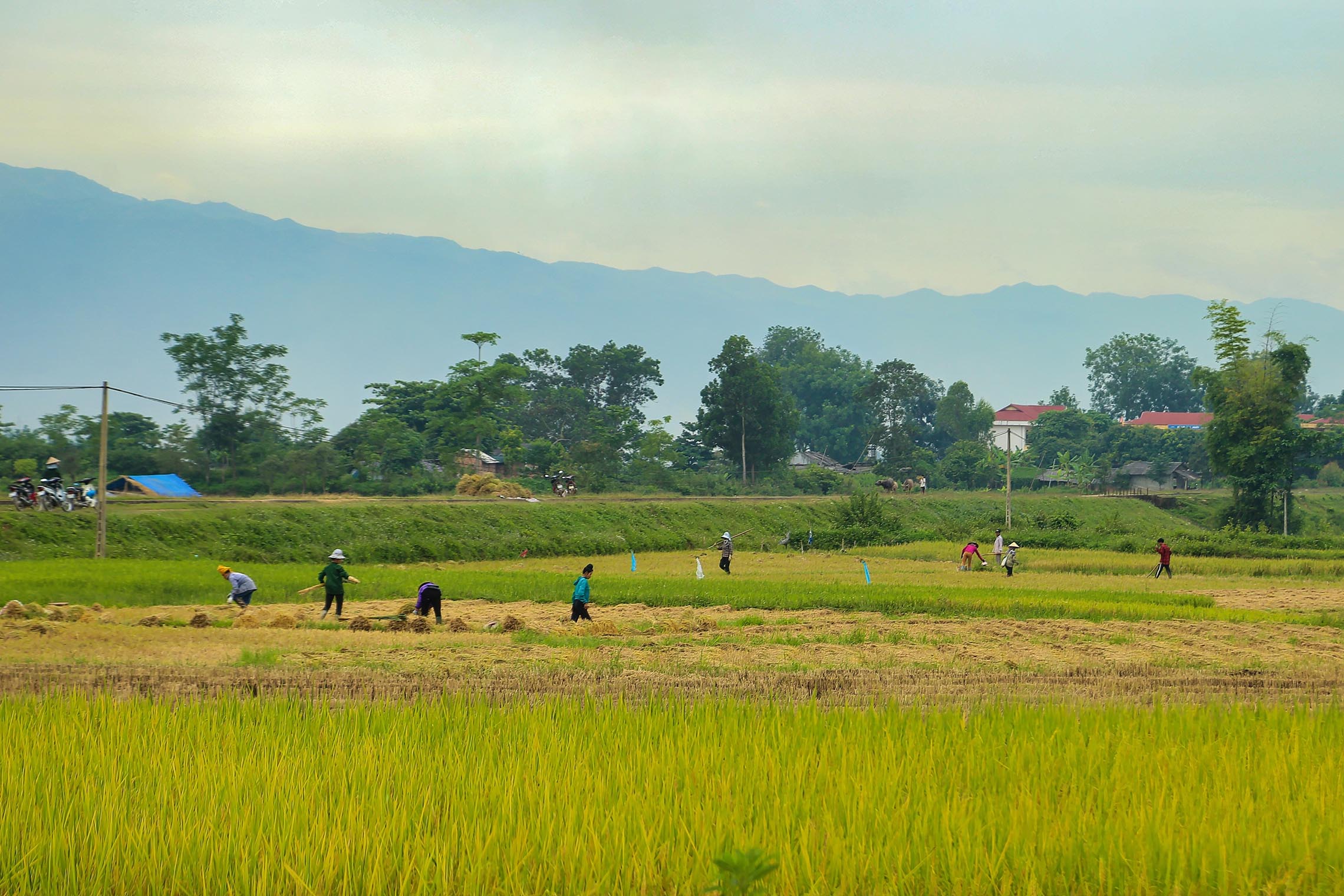
 Khung cảnh cánh đồng Mường Thanh, Điện Biên

Scenic view of Muong Thanh rice fields in Dien Bien during the harvest season

September brings the valley into its busiest and most beautiful season, as ripening rice turns the paddies luminous gold, its heavy heads bending gently in the breeze before harvest. From early morning, farmers move through the fields with sickles, cutting and gathering rice into sheaves before carrying the harvest along narrow paths, while freshly cut bundles gather beside the roads and village life continues around them.

Seen from the surrounding heights, these details merge into a vast panorama of golden fields stretching across the valley, winding paths, village houses and farmers moving through the harvest. Together, they create a scene both expansive and deeply intimate, where the scale of the mountains meets the quiet persistence of human hands, leaving a lasting impression of a landscape at its most abundant and the people whose work has brought it to life.

For generations, Muong Thanh has been central to the lives of communities cultivating its fertile plain, with harvest time still following the practical routines of work, family and village life. Among the places to visit in Dien Bien, the valley leaves a lasting impression through its sheer visual splendour, with golden fields beneath towering mountains and the quiet movement of people bringing the whole valley vividly to life.

Walk the hills where the Dien Bien Phu Campaign unfolded

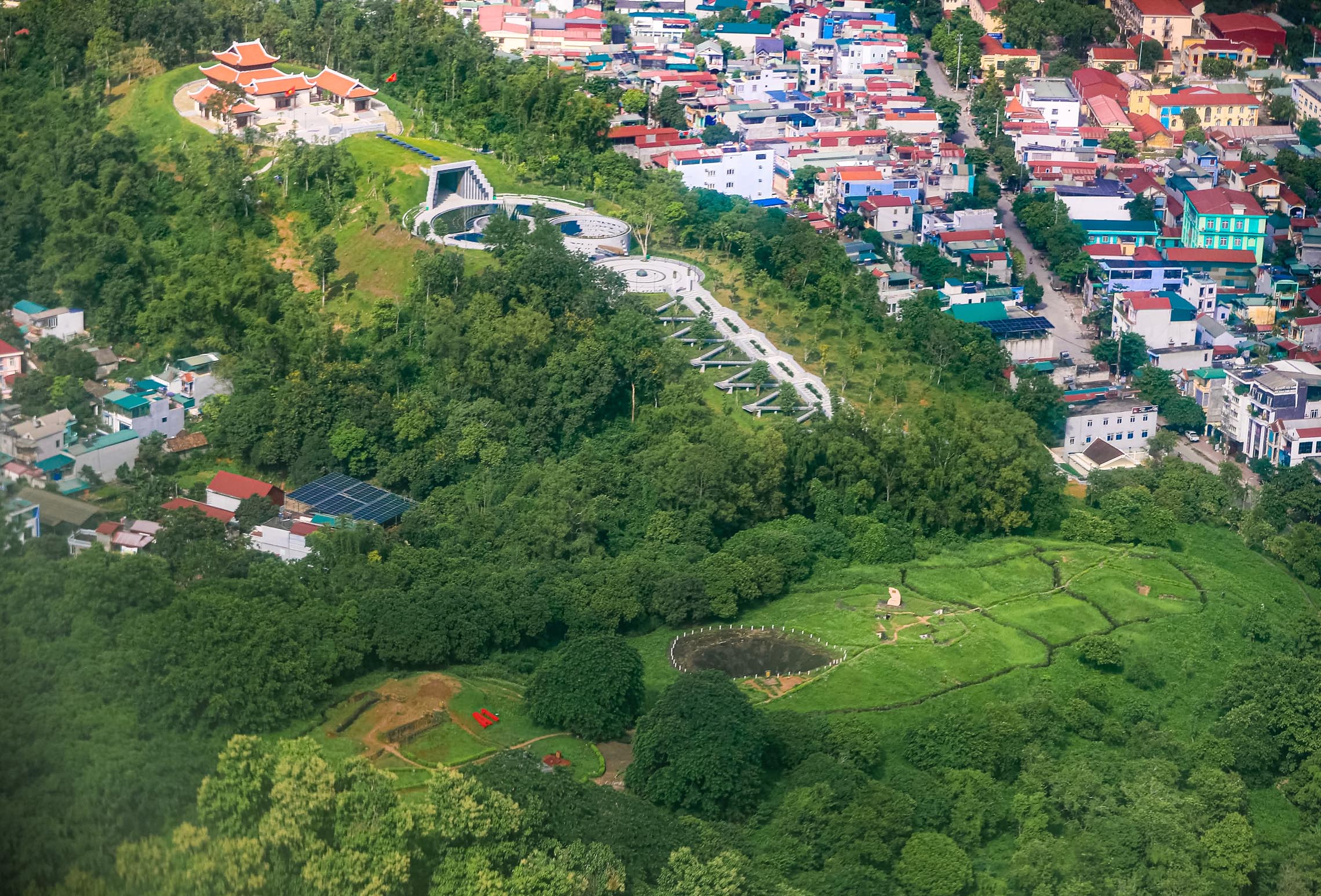
To understand Dien Bien Phu, it is necessary to leave the abstract language of military history and follow the terrain itself. Passing the tranquil waters of Pa Khoang Lake, the road towards Muong Phang climbs through ancient forest at the foot of Pu Don Mountain to reach the Dien Bien Phu Campaign Headquarters, where General Vo Nguyen Giap and the Campaign Command lived and worked in simple bamboo huts and a mountain tunnel for 105 days (from January 31 to May 15, 1954). Back on the valley floor, A1 Hill (the pivotal eastern stronghold Eliane 2, still marked by trenches and the massive crater of a 960-kilogram underground explosive charge), the fortified De Castries Command Bunker, and D1 Hill crowned by the 220-tonne bronze Dien Bien Phu Victory Monument rise across the former battlefield. Further across the valley, Him Lam, Ban Keo and Doc Lap recall the early stages of the fighting, when control of these strategic heights demanded immense physical endurance and careful movement through difficult mountain country.

(A1 Hill, a historic battlefield site in Dien Bien Phu is one of the most famous places in Dien Bien

A1 Hill, a historic battlefield site in Dien Bien Phu is one of the most famous places in Dien Bien

The steep climbs between these former positions, the narrow approaches through the hills and the open ridgelines overlooking the valley give a physical dimension to the campaign, while the quiet surroundings today make the contrast all the more striking. Against this backdrop, forest canopies move gently in the mountain air, cultivated fields stretch beneath distant peaks, and the encounter between the serenity of contemporary Dien Bien and the courage once demanded here gives the landscape a profound emotional weight. For Vietnamese visitors especially, standing among these hills evokes pride in a national victory whose significance extends far beyond the battlefield itself.

Step inside the campaign at Dien Bien Phu Historical Victory Museum

After the quiet hills and open fields of the former battlefield, the Dien Bien Phu Historical Victory Museum offers an intimate encounter with the campaign. More than 1,000 documents and artefacts preserve moments from those extraordinary months, including photographs, personal belongings and military equipment that followed soldiers through the mountains. A worn possession or faded photograph can suggest the human cost behind a military operation usually remembered through maps, dates and strategic movements.

Housed inside a striking rotunda shaped like the camouflage-netted bamboo helmet worn by Dien Bien soldiers, the museum’s centrepiece is the monumental 360-degree Panorama painting of the Dien Bien Phu Campaign – measuring 132 metres long, 20.5 metres high and 42 metres in diameter across 3,225 square metres, created by nearly 100 artists to bring 56 days and nights of combat vividly to life. Yet the scale of the painting becomes more personal through the wartime objects displayed around it, whose worn surfaces and modest forms recall the soldiers who carried, used and relied on them through the campaign, bringing the image of those who fought to protect their homeland closer to the present. In this way, the soldiers appearing amid the confusion of movement and combat are no longer distant figures in a vast historical scene, while the surrounding landscape places their struggle within the formidable geography seen outside the museum. After standing among the former positions, encountering these faces and fragments of daily life gives the campaign an emotional dimension, ending with a profound sense of pride in the courage and sacrifice behind the victory.

Things to do in Dien Bien for an immersive journey through nature

History may be the province’s most recognisable story, but the landscape beyond the battlefield has its own pull, extending into remote forests, limestone caves and its multicultural highland communities.

The beauty of Muong Nhe Primeval Forest

Far to the northwest, Muong Nhe Primeval Forest leads into one of Dien Bien’s most remote corners, where dense foliage climbs across highland slopes and deep valleys disappear beneath a vast canopy. The forest stretches across rugged terrain in layers of ancient trees, distant ridgelines and shadowed valleys, creating a sense of depth and wilderness that feels worlds apart from the cultivated expanse of Muong Thanh. At the heart of this beauty is the life held within the forest, from towering old-growth trees and rare plants to wildlife moving through the secluded woodland, lending the landscape a quiet, almost untouched quality.

Roads wind through sparsely settled uplands, passing communities whose lives remain closely connected with the surrounding wilderness and mountain terrain. At the far western tip of Muong Nhe lies A Pa Chai atop Khoan La San Peak in Sin Thau Commune – the tri-border junction of Vietnam, Laos and China, poetically known as the place where 'a single rooster's crow is heard across three countries'. For those seeking things to do in Dien Bien beyond its celebrated battlefields, Muong Nhe and the A Pa Chai Flag Tower offer an unforgettable journey to Vietnam's westernmost frontier.

Discover Dien Bien’s caves through stone and legend

Deep beneath Dien Bien’s mountains, Pa Thom Cave opens into a world where ancient stone meets ancestral belief. Here, limestone walls surround chambers filled with striking formations, including shapes likened to an elephant’s head and a giant python, while people living around the cavern associate it with a tale of two lovers whose devotion was tested by fate. Such legends remain part of the spiritual life of nearby villages, connecting the cavern with beliefs and memories handed down through generations.

Tham Pua Cave has broader chambers and a more elemental beauty, with stalactites and stalagmites formed through immense stretches of geological time. Cool air replaces the warmth outside as daylight fades behind the entrance, while muffled silence deepens underground and every irregular surface catches the faintest trace of light.

Together, the two caverns express the richness of Dien Bien’s highland heritage, where geological wonders sit alongside deeply rooted beliefs and centuries-old imagination.

 Khung cảnh bên trong một hang động tại Tủa Chùa, Điện Biên

Explore a scenic cave in Tua Chua District, Dien Bien

Relax at Hua Pe and U Va Hot Mineral Springs

After a day spent exploring Dien Bien’s historic sites, Hua Pe and U Va Hot Mineral Springs invite a slower pace, with natural thermal waters (ranging from 60°C to 80°C) framed by wooded slopes and serene lakeside scenery. Steam rises gently from the pools as mountain air settles around the springs, creating a soothing atmosphere that feels far removed from the roads and monuments explored earlier.

The springs also belong to everyday life in the surrounding countryside, where bathing in mineral water has long been associated with rest and physical wellbeing. Sitting in the warmth while distant hills stretch across the horizon allows the landscape to be appreciated through touch, temperature and silence, adding a restorative dimension to a journey through Dien Bien’s rugged uplands.

Pha Din Pass – Crossing one of Vietnam’s Four Great Mountain Passes

Stretching 32 kilometres along National Highway 6 between Son La and Dien Bien provinces and reaching an elevation of 1,648 metres, Pha Din Pass – whose Thai name ('Pha Đin') means 'where heaven and earth meet' – belongs to Northwest Vietnam’s legendary 'Four Great Passes', curling along sheer cliffs above deep valleys. Meanwhile, the scenery grows increasingly immense with every kilometre, opening onto deeper valleys, sharper slopes and distant peaks layered across the Northwest until the sheer scale of the highlands begins to feel almost overwhelming.

Weather lends its own atmosphere to the crossing, as clear skies allow sunlight to sweep across the ridges and illuminate the vast mountain country, while clouds gathering around the summit soften the contours and narrow the view to the winding road and slopes close at hand, creating an ever-shifting sense of distance and scale. By the time the pass descends towards the valley, the journey leaves travellers with a profound sense of awe at the grandeur of nature and the extraordinary scale of Dien Bien’s mountainous landscape.

Quick information

Frequently Asked Questions

March is known for white ban flowers and the Ban Flower Festival. August and September are ideal for seeing Muong Thanh Valley during rice harvest, when the fields turn golden. November and December are another appealing period, particularly for travellers interested in wild sunflowers and cooler highland weather.

For travellers comparing places to visit in Dien Bien, three days and two nights is a practical starting point for combining the principal historical sites with one or two nature excursions. An independent trip can cost around VND 4 – VND 7 million per person, depending on transport, accommodation and activities.

Beyond the battlefield, visitors can encounter highland culture in Thai cultural villages such as Men, Ten, Che Can and Phieng Loi, where UNESCO-listed Thai Xoe folk dancing and brocade weaving remain vibrant parts of community life. Suc Village provides another hot-spring experience, while Tua Chua Highland Market offers a closer look at trade and everyday exchange in the uplands.

What to eat in Dien Bien: A taste of mountain culture

By late afternoon, smoke begins to rise from the kitchens of Dien Bien’s stilt houses. At the house’s center, river fish is clamped between bamboo sticks over glowing charcoal, sticky rice is lifted from wooden steamers, and herbs are pounded with Mac khen (a fragrant Northwest Vietnamese wild pepper) until their fragrance fills the room. Outside, the mountains slowly disappear into the evening mist, and inside, the table begins to gather the flavours of rivers, rice fields and forests.

For anyone wondering what to eat in Dien Bien, the answer lies not only in its best-known specialties but in the food traditions of the communities who have lived across these valleys and highlands for generations. Thai, Hmong, Ha Nhi and Lao cuisines each have their own ingredients, techniques and rituals, yet all share a close relationship with what grows, swims and can be gathered nearby.

Discover the flavors of the mountains in Dien Bien local food

Dien Bien local food brings a strong regional identity to the journey, adding another dimension to the province alongside its mountains, history and cultural heritage.

Pa Pinh Top: A Northwest classic over glowing coals

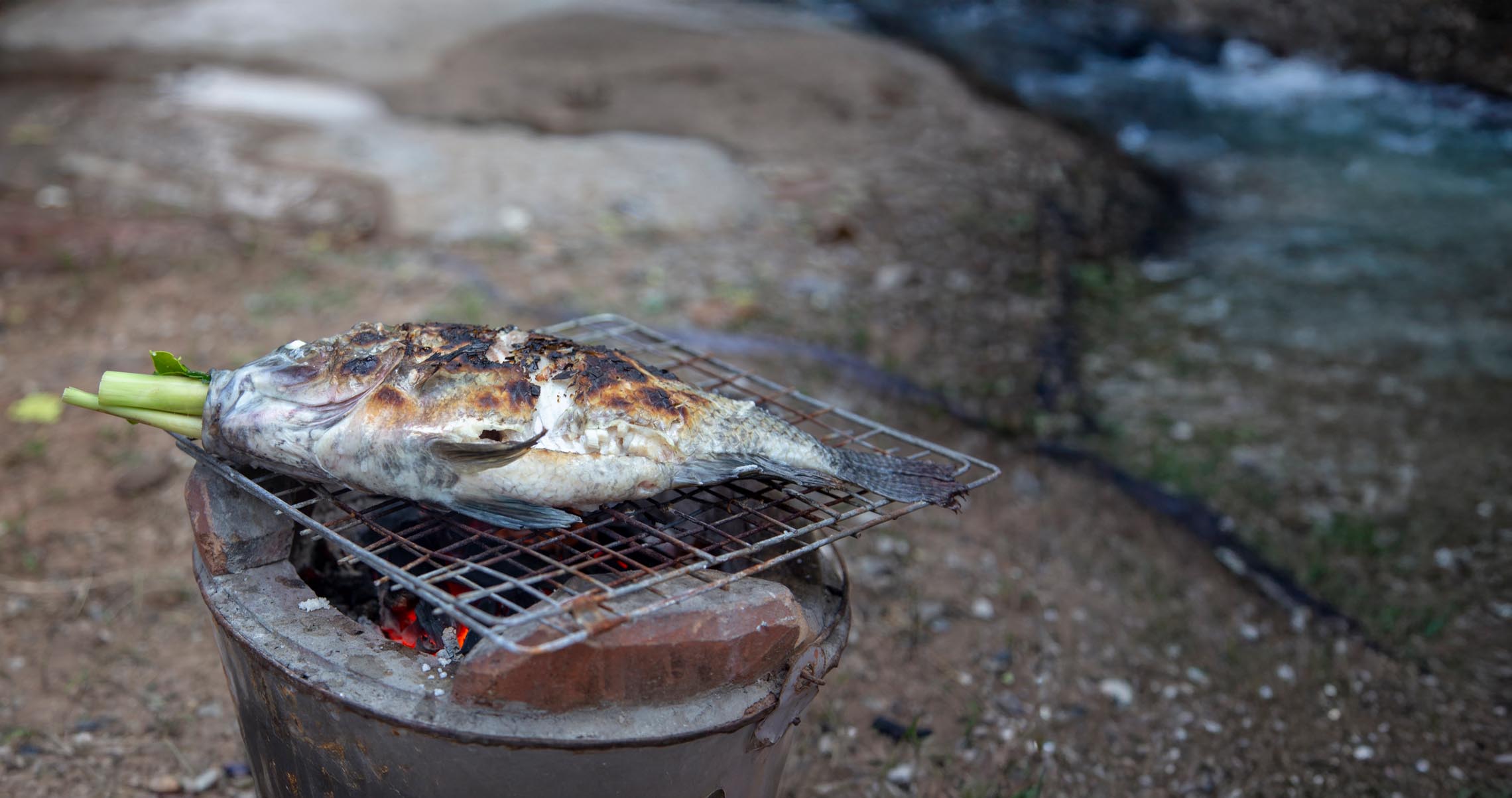
A journey through Dien Bien would hardly feel complete without tasting Pa Pinh Top, the celebrated grilled fish of the Thai people, whose distinctive preparation begins with fresh carp, grass carp or mud carp. The fish is split along the backbone and opened flat, then rubbed with chopped herbs, garlic, chilli and wild pepper before being folded together and secured between bamboo sticks. As the fish settles over glowing embers, its skin slowly crisps and blisters, while fragrant smoke rises around the bamboo frame.

The aroma of grilled fish is immediate, with toasted garlic, fresh herbs and the citrusy, slightly peppery fragrance of wild pepper leaves mingling above the fire. Beneath the crisp skin, the flesh stays moist and tender, its delicate sweetness followed by chilli warmth and a gentle tingling sensation from the spice. Pa Pinh Top is traditionally shared with Cham Cheo (Northwest Vietnamese dipping sauce) and Northwest-style rice wine, often appearing at weddings and gatherings where honoured guests are welcomed. Alongside Pa Pinh Top, Thai hosts frequently serve Ga Nuong Mac Khen (free-range hill chicken marinated with wild pepper, lemongrass and lime leaves, then slow-roasted over wood embers until the skin turns crisp and golden) and Reu Da (fresh green stream moss beaten on river stones, seasoned with wild spices and steamed in banana leaves), expressing generosity and highland hospitality.

Dien Bien upland sticky rice from field to table

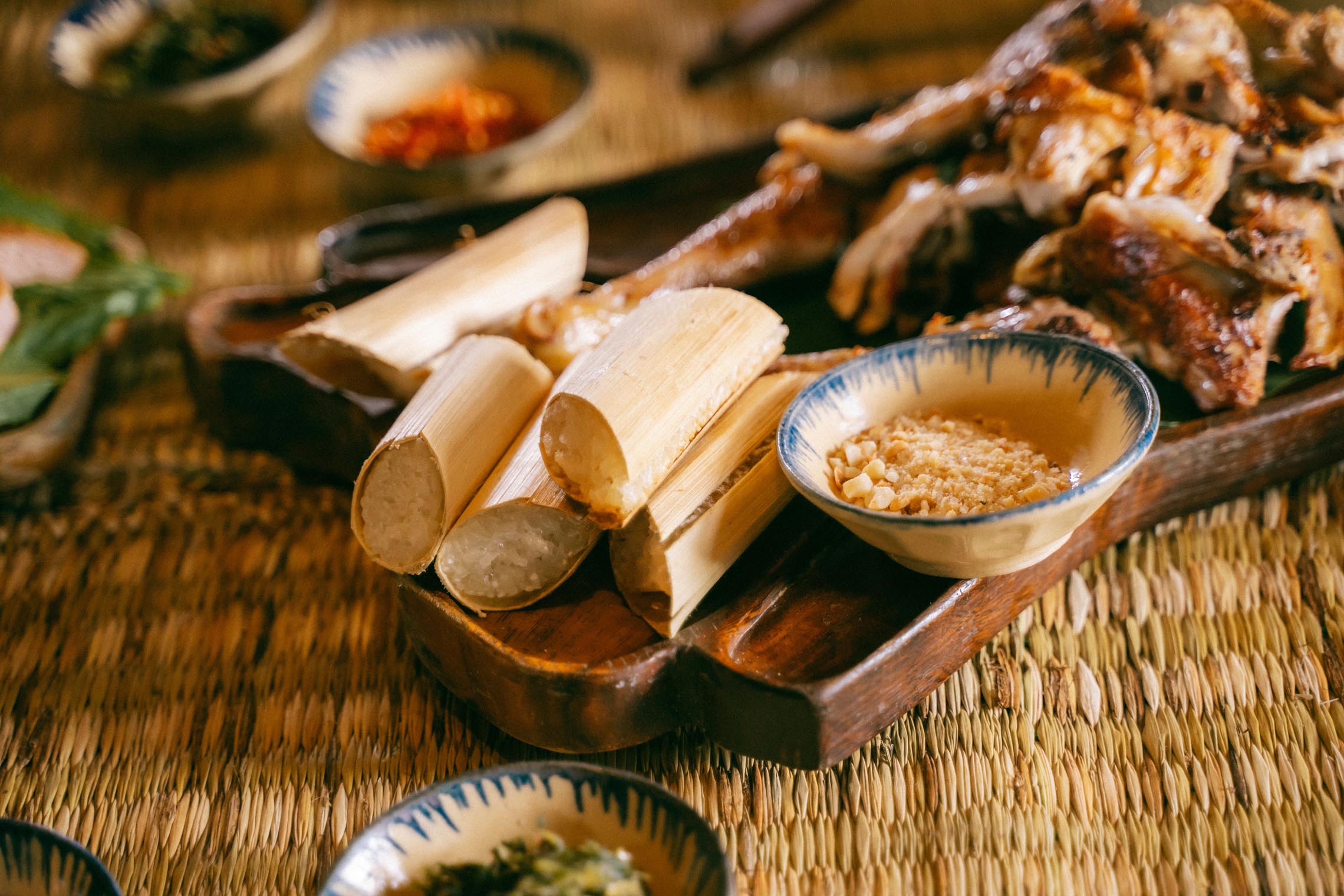
Beside a bamboo-grilled Pa Pinh Top, a mound of Com Nep Vung Cao Dien Bien (Dien Bien upland sticky rice) arrives wrapped in the fragrance of freshly steamed grain, its gentle sweetness softening the charred, spicy flavours of the fish. Long before this moment at the table, the rice has passed through the hands of farmers working the fertile valleys, where glutinous rice has been cultivated across generations. The grains are soaked for several hours, then placed inside a traditional wooden khót (wooden sticky-rice steamer) and steamed over two rounds of fire, the cook watching the heat until each grain becomes plump, glossy and fragrant.

Xôi nếp nương Điện Biên

Traditional Dien Bien sticky rice served in a rustic basket

When the lid is lifted, warm vapour rises from the basket, carrying the unmistakable perfume of new rice. Soft and chewy with a delicate stickiness, the grains hold their texture without becoming heavy, pairing naturally with grilled and wood-fired dishes. Wrapped in dong or banana leaves, rice also travels from the kitchen into the fields, where farmers eat between hours of work. Its place reaches further into tradition during new-rice ceremonies, when the first harvest is prepared as an offering to ancestors. The same grain then returns to family tables, linking the season’s harvest with memory, gratitude and generations of highland life.

Canh Thuc Bon for cool mountain evenings

When the first cool rains settle over Dien Bien, Canh Thuc Bon (Bon stem soup) appears at the family table here in a pot still trembling with heat, its broth carrying the earthy fragrance of bon stems, herbs and wild pepper. The stems are peeled and washed before simmering with prepared buffalo skin, while banana blossom, chilli and wild pepper leaves are pounded by hand and added gradually, allowing their aromas to deepen as the broth cooks.

The dish belongs to an older highland cooking tradition in which ingredients from fields, gardens and forest margins were put to careful use, with buffalo raised for farming and bon stems gathered as part of seasonal foodways. Slow cooking softens the stems and removes their sharp itchiness, leaving a tender texture with a faint chew, while buffalo skin lends richness and the herbs add layers of earthy, spicy fragrance.

Served with bamboo-cooked rice, the soup has long suited the cooler months and rainy days of mountain life, when a hot broth becomes part of the evening meal. Its preparation preserves practical knowledge passed through generations, from handling the stems safely to balancing pungent spices, connecting an everyday dish with the food traditions of Dien Bien’s highland communities.

What to eat in Dien Bien for a taste of local multi-culture

People carry culinary knowledge through generations, preserved in the instinctive gestures of cooks, the customs surrounding a shared table, and the techniques used to prepare and serve food. In Dien Bien, these practices form a rich inheritance, where cooking, dining and communal occasions remain closely connected, giving the cuisine here a deeper significance.

An introduction to Hmong Cuisine

On the highland slopes, corn dries beneath the mountain sun before being ground for the kitchen, its earthy fragrance familiar in Hmong households across Dien Bien. At elevations where fertile ground is scarce, Hmong cooks have long turned this hardy crop into Men Men (steamed ground corn), steaming finely ground corn into a fragrant, sustaining staple, while Ruou Ngo (corn wine) transforms the same grain into a potent drink served during gatherings and celebrations.

Beside these corn-based foods, Thang Co (Hmong meat stew) simmers meat and herbs slowly until the broth becomes rich and deeply savoury, a dish closely associated with communal occasions. Together, these preparations show how Hmong cuisine draws ingenuity from a demanding environment, turning modest crops and carefully prepared meats into food and drink with a distinctly Hmong identity.

Explore Ha Nhi’s fascinating pantry

In Dien Bien’s far-western highlands, Go Pa Go Che (Dried pickled vegetables) is a familiar presence in Ha Nhi households, appearing in daily cooking as well as Tet (Vietnamese Lunar New Year) feasts and occasions when guests are welcomed. One of the most important ingredients of the dish - mustard greens are sun-dried, cut and salted without being submerged in water, concentrating their flavour while allowing the pickle to remain edible for long periods.

The technique of preservation suits remote mountain life, particularly during journeys to fields or forests when fresh vegetables are scarce. Its sharp acidity pairs beautifully with smoked pork belly, cutting through the meat’s richness, while stream fish lends a gentler savoury note. For the Ha Nhi, serving preserved vegetables alongside a generous spread is part of receiving guests with care, giving this humble jar a place at both everyday meals and important celebrations.

Lao cuisine at the heart of the mountain

For centuries, Lao communities have lived across the valleys and mountain settlements of Dien Bien, with movement between the Northwest and neighbouring Laos allowing food customs to travel alongside families, trade and seasonal exchange. That history remains visible at the table through Lao Larb (Lao minced meat salad), a savoury dish of finely minced meat seasoned with toasted rice, herbs and lime juice. Accompanying the dish, toasted rice lends a warm, lightly nutty fragrance and delicate crunch, while lime cuts through the richness of the meat with a clean acidity.

The Lao repertoire also makes use of bon stems and buffalo skin, ingredients found elsewhere in Northwest cooking yet prepared according to Lao preferences. Rather than existing apart from the surrounding foodways, these dishes speak to centuries of movement across the mountains, where familiar ingredients acquired distinctive flavours through the customs of each community.

At the heart of Thai table

Among Thai communities in Dien Bien, Cham Cheo (Wild pepper leaves dipping sauce) is one of those preparations that can identify a meal before the first bite. In a wooden kitchen, wild pepper leaves, chilli, garlic and fresh herbs are pounded together until the mortar releases a sharp, citrus-like fragrance, followed by the gentle heat of chilli and the distinctive tingling of the pepper. The ingredients come from the surrounding uplands and household gardens, giving the sauce a flavour deeply rooted in the foodways of the region.

Cham Cheo appears at family meals, festive gatherings and occasions when guests are welcomed, placed beside grilled chicken, smoked buffalo meat, boiled vegetables or bitter bamboo shoots. Each bite changes as the food meets the sauce, with sour, salty, spicy and aromatic notes arriving in quick succession. This is what makes the condiment so distinctive at the Thai table: a small bowl can transform simple mountain produce into a vivid expression of taste, hospitality and daily life in Dien Bien.

From charcoal-grilled fish to sticky rice carried into the fields, from preserved vegetables to corn wine poured at a gathering, the flavours of Dien Bien local food remain simple in origin but deeply rooted in place, carrying the seasons, customs and memories of the Northwest into every meal.

Trải nghiệm cá tươi nướng than bên cạnh một thác nước thiên nhiên

Whole fish grilled over charcoal in traditional Dien Bien Thai ethnic style

Quick information

Frequently Asked Questions

Visitors can explore Dien Bien Central Market, highland markets and food streets in Dien Bien Phu City, where they can sample grilled meat skewers, black sticky rice cakes and other local snacks while experiencing everyday food culture.

Community-based cultural tourism villages such as Phieng Loi and Men villages offer a more authentic experience, with traditional meals prepared by local residents using regional ingredients and recipes passed down through generations.

Dien Bien cuisine captures the distinctive flavors of Vietnam’s Northwest through stream fish, wild greens and upland rice, paired with mountain spices such as Mắc khén and doi seeds. Traditional grilling, steaming and wood-fire cooking further define its character.

A journey to Vietnam’s Northwest

Before Dien Bien appears on the map, it arrives through sound: An engine climbing a mountain pass, rain tapping against a coach window, or the sudden quiet after a flight descends over green valleys. Reaching this northwestern province is part of the experience, with roads winding through uplands and air routes shortening the journey to Dien Bien Phu. For first-time visitors, knowing how to get to Dien Bien is also a chance to choose the pace at which the landscape, history and local life come into view.

How to get to Dien Bien for the ultimate experiences

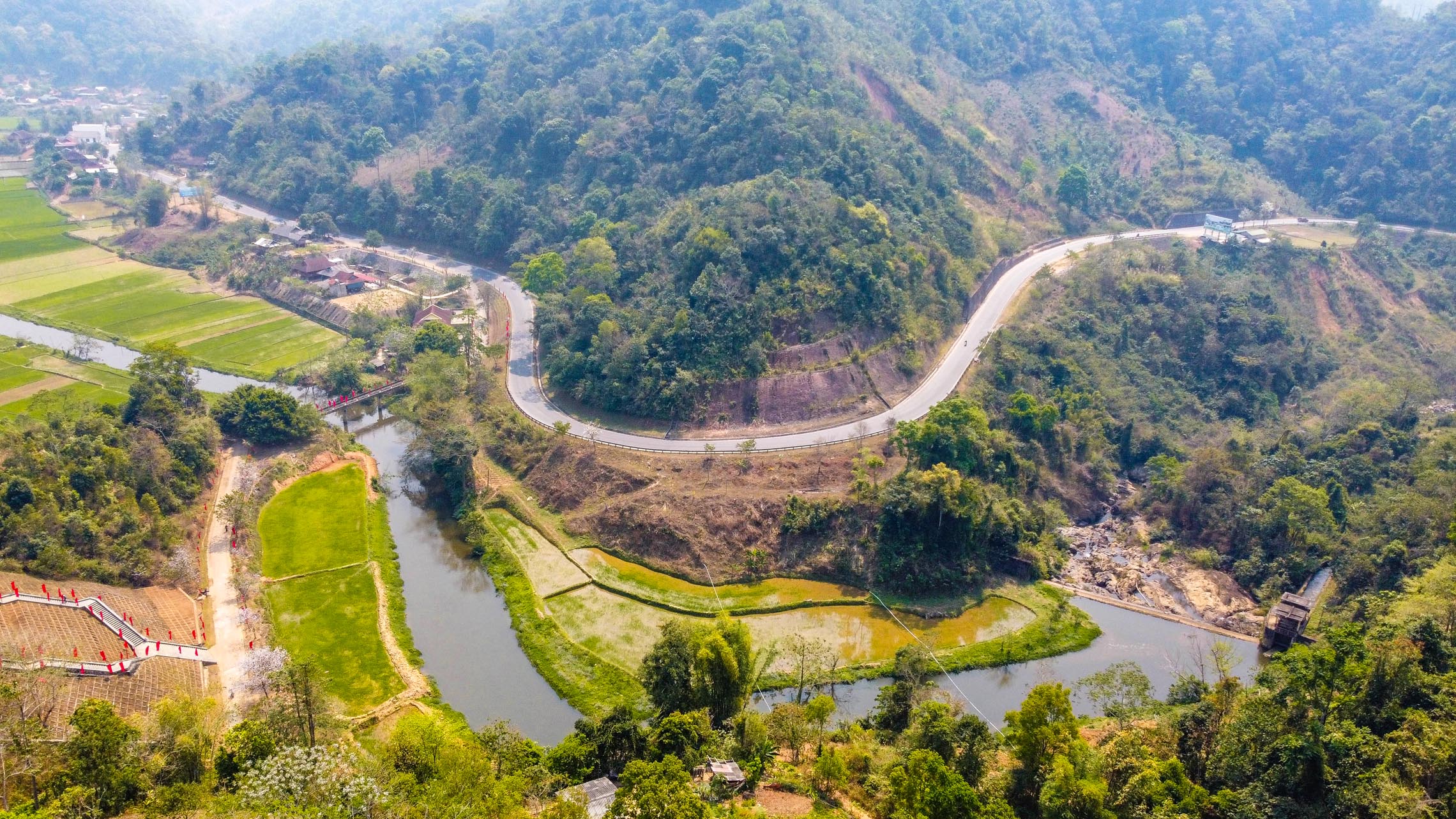
Cung đường đèo lên thành phố Điện Biên Phủ

Scenic mountain roads through Dien Bien Phu

Adventuring into Dien Bien by road

The road to Dien Bien begins as Hanoi gradually recedes behind the windows, with coaches connecting the capital to Dien Bien and several northern provinces throughout the day. Overnight services from My Dinh, Giap Bat and Yen Nghia take around 10 hours, allowing passengers to wake as the journey reaches the Northwest, where mist hangs above wooded slopes, roadside kitchens kindle their fires and villages begin another day beneath the mountains.

Those driving can follow National Highways 6, 32 and 37, with navigation apps useful for directions as the road climbs deeper into the Northwest. Lowland streets gradually disappear, houses become more scattered and the scenery grows increasingly rugged, with valleys opening beneath steep slopes and winding sections demanding greater concentration from the driver. Rain and mist can slow progress across higher ground, adding another layer of unpredictability to the journey.

Along the way, small scenes appear beside the road, from markets setting up in the early hours to farmers carrying baskets towards their fields, wooden houses emerging between trees and roadside stalls serving hot food to passing drivers. Sunlight moves across distant ridges as the road climbs, while settlements become farther apart and forests occupy longer stretches of the route. By the time Dien Bien arrives, the landscape has already travelled from lowland bustle into mountain stillness.

Starting the journey at Dien Bien Airport – Fast air connections to Muong Thanh Valley

For visitors with limited time, flying to Dien Bien brings the Northwest within easy reach, with Dien Bien Airport located in Dien Bien Phu City beside the broad Muong Thanh Valley. Flights from Hanoi take around 55 minutes, while services from Ho Chi Minh City take approximately 2 hours 20 minutes. The airport itself is compact and straightforward, with essential passenger facilities, check-in counters, baggage services and waiting areas arranged for arrivals and departures without the bustle of a major metropolitan terminal.

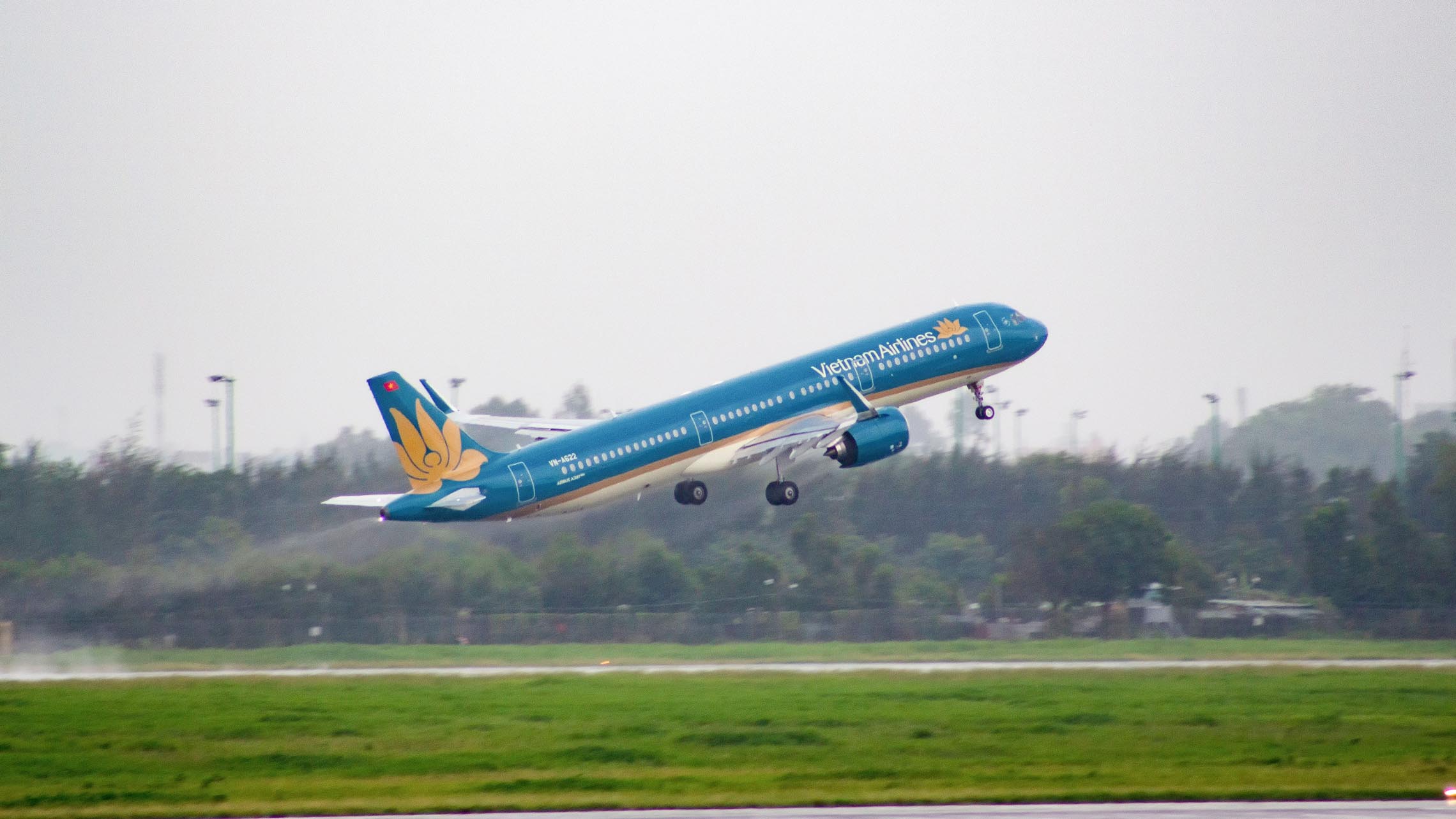
Máy bay của Vietnam Airlines cất cánh từ đường băng Cảng hàng không Điện Biên

Passengers boarding a Vietnam Airlines flight to Dien Bien Airport

Before departure, flight schedules and advance reservations can be arranged ahead of busy periods and major events such as the Dien Bien Ban Flower Festival, with TripCare insurance available as an optional addition when preparing for the journey. Once airborne, the practicalities of travel quickly give way to the landscape below, as the broad fields of Muong Thanh appear between successive mountain ranges, with the Nam Rom River tracing through the valley and settlements scattered across the basin. By the time the aircraft descends towards the runway, the mountains have already filled the horizon, while the valley below offers a first glimpse of the landscape awaiting exploration.

Ways of getting around Dien Bien

Once in Dien Bien, local transport becomes part of discovering its different landscapes and communities. Distances between the urban centre, historical sites and highland villages can be considerable, so choosing the right vehicle helps keep the journey comfortable without limiting where you can go.

Choose the right Dien Bien local transportation

A motorbike gives greater freedom once the journey moves beyond Dien Bien Phu City, particularly for routes leading towards cultural villages, markets and quieter stretches of countryside. The flexibility to stop beside a rice field, pause at a roadside stall or take a short detour can make a considerable difference in a mountainous province, although mountain roads require confidence and careful handling, especially when rain has made the surface slippery.

Taxis and private cars are a more comfortable choice for families, larger groups or anyone travelling with elderly relatives and young children. They also make it easier to visit several sites around Dien Bien Phu without spending long hours concentrating on unfamiliar bends and steep sections, while a local driver can be particularly useful on roads where conditions change quickly.

Things to keep in mind

Weather deserves attention before setting out, particularly from June to August when heavy rain can leave mountain roads slick and increase the possibility of landslides or falling rocks along national highways. Checking forecasts and road conditions before departure is advisable, while routes into higher areas may require extra caution because narrow lanes and sharp bends can appear with little warning.

Allowing generous travel time also leaves room for the unexpected. A short distance on the map can take much longer once the road begins climbing, while a roadside market, village gathering or sudden view across the valley may be worth a brief pause. In the mountains, a flexible itinerary makes space for both changing conditions and the small scenes that give a journey through Dien Bien its character.

Quick information

Frequently Asked Questions

National Highway 6 is one of the most popular routes, connecting the Northwest through Hoa Binh and Son La before crossing Pha Din Pass into Dien Bien. The journey covers roughly 450km – 500km, with dramatic mountain views, but also steep climbs and winding sections that require confident driving and extra travel time.

Taxis are widely available in Dien Bien Phu City, making them a practical choice for getting around the urban area and travelling between major sights. Several established operators serve the city, while ride-hailing services remain limited compared with larger Vietnamese cities.

Yes. Several major historical sites in central Dien Bien Phu are close enough to explore on foot, including the Dien Bien Phu Victory Museum, A1 Hill and the De Castries Bunker. Walking between these sites also gives visitors a closer look at the city’s streets and everyday atmosphere.

Places to stay in Dien Bien: Where the landscape becomes part of the stay

Few places make choosing where to sleep feel so closely tied to the geography of a journey as Dien Bien. With a wide range of accommodation , from comfortable city stays to quieter retreats and homestays in rural areas, each setting brings a distinct atmosphere to the hours between excursions.

Recommended comfortable Dien Bien Phu accommodation

A traveller might imagine Dien Bien Phu City as a straightforward urban base, yet its hotels and guesthouses place historic sites, cafés and everyday services within easy reach, while mountains remain visible beyond the streets. By evening, returning to the city means quieter roads, familiar comforts and the surrounding countryside still lingering on the horizon.

Comfortable hotels and eco-resorts in Dien Bien Phu City

For couples, families, groups of friends and business travellers, hotels in Dien Bien provide a convenient place to stay while exploring the city and surrounding attractions, with spacious rooms, modern interiors and family-friendly amenities making the return after a long day. Whether the hours have been spent walking through historical sites or travelling along winding mountain roads, resorts and eco-resorts here provide a quieter alternative through open grounds, greenery and views towards the surrounding highlands.

Panoramic view of Muong Thanh Valley from hotels in Dien Bien Phu

Panoramic view of Muong Thanh Valley from hotels in Dien Bien Phu

What makes staying here interesting is not simply what happens inside the room, since stepping outside places the traveller in the middle of the city’s everyday routine, where breakfast stalls grow busy, people move between markets and workplaces, and cafés gradually fill with conversation. These everyday scenes add texture to a journey that might otherwise be defined largely by its major historical landmarks, while an eco-resort shifts the focus towards open space and the slower pace of the countryside.

The central setting is especially useful for different types of journeys, allowing couples to return easily after exploring the region, families to keep practical services close at hand, groups to gather before heading farther into the province, and business travellers to maintain a predictable schedule, with accommodation providing a quiet interval between excursions rather than becoming the focus of the trip.

Although contemporary facilities remain close, mountains continue across the horizon beyond the built-up area, keeping Dien Bien Phu City closely connected to its highland setting and allowing the surrounding landscape to remain part of the stay.

Muong Thanh Valley views from your stay

Imagine waking up in a hotel overlooking Muong Thanh Valley, with dawn spreading softly across rice paddies, narrow roads winding between settlements and wooded slopes rising towards distant ridges. From the window, the scenery can be watched at leisure instead of glimpsed between excursions, revealing small details that disappear from a moving vehicle, from farmers crossing the fields to rooftops emerging among the greenery.

Cánh đồng Mường Thanh gần các khách sạn, khu nghỉ dưỡng tại Điện Biên

Farmers harvesting ripe rice in Muong Thanh Field, Dien Bien, a common view from homestays in Dien Bien’s countryside

Muong Thanh is also the agricultural heart of Dien Bien, a broad fertile plain that has supported cultivation and settlement across the surrounding highlands for generations. Seen from above, its geography becomes remarkably legible, with rice paddies occupying the basin, homes gathered along roads and higher ground enclosing the plain on every side. The panorama explains why this stretch of countryside holds such importance in the province’s identity.

The pleasure of staying here comes through unhurried observation, when sunlight shifts across the paddies, rain darkens distant slopes or clouds gather around the peaks, changing the appearance of the countryside without requiring a journey elsewhere. A window becomes an unobtrusive vantage point, allowing half an hour to pass simply watching the day develop outside.

For visitors seeking comfort while remaining visually connected to the Northwest, accommodation overlooking Muong Thanh gives the stay a strong visual connection to its surroundings, pairing contemporary interiors with an expansive rural panorama that remains close from morning until evening.

Inside the signature places to stay in Dien Bien

What better way to understand everyday life in Dien Bien than to stay under the same roof as a family who lives it every day? Community-based homestays place guests within village life, where a shared meal, conversation after dinner or the quiet activity around a traditional house can reveal far more about people and customs than a brief visit ever could.

Traditional Thai stilt houses around Dien Bien

Dien Bien is home to renowned Thai cultural tourism villages – including Men, Ten, Che Can, Phieng Loi, Him Lam 2, Noong Chun, Noong Bua and Keo – where traditional Thai stilt houses welcome young travellers, groups of friends and families seeking an affordable stay close to the region’s cultural and natural heritage. Raised on sturdy timber posts, these houses have broad wooden floors, generous open-plan interiors and woven textiles whose colours stand out against the warm grain of the wood.

The design has evolved around the highland climate, with the elevated structure allowing air to pass beneath the house while the upper floor remains airy and shaded. Wide living areas leave space for sleeping, dining and gathering, and the absence of enclosed corridors gives the interior an unusual openness.

For a guest accustomed to polished city accommodation, the first night can feel wonderfully unfamiliar. Bare feet meet smooth timber, cool air moves through the open interior and the village remains visible beyond the veranda, where woven fabrics stir gently in the evening breeze. As darkness settles over the surrounding fields, the house grows quieter without ever becoming completely silent, leaving the sounds of conversation and distant movement to accompany the night.

Living with local culture at a homestay

A homestay in Dien Bien can open the door to activities seldom found in a conventional stay. Each activity invites curiosity, whether a first attempt at a delicate stitch, the patient handling of a strip of bamboo or the discovery of unfamiliar flavours at the table.

Brocade weaving has its own visual language, with motifs and colour combinations passed through generations and reproduced through painstaking handwork. Bamboo and rattan reveal another form of expertise, as everyday materials become baskets, trays and household objects through techniques learnt through years of practice. Watching the process at close range makes the skill behind an apparently simple object much easier to appreciate.

Food introduces another layer of familiarity, particularly when a meal is shared with residents instead of encountered as a finished dish. Ingredients, preparation methods and serving customs all belong to the occasion, while conversation around the table can illuminate family habits and social etiquette that remain hidden during a brief visit.

Families and younger travellers may find these exchanges especially rewarding because participation leaves room for spontaneity, whether helping with a craft, tasting something unfamiliar or joining a conversation after the day’s work has finished. A handmade piece, a particular flavour or a new understanding of a familiar custom can remain vivid long after the stay has ended.

For those seeking Dien Bien Phu accommodations, these exchanges place cultural traditions at the heart of the stay, with a homestay offering a direct way to learn through participation.

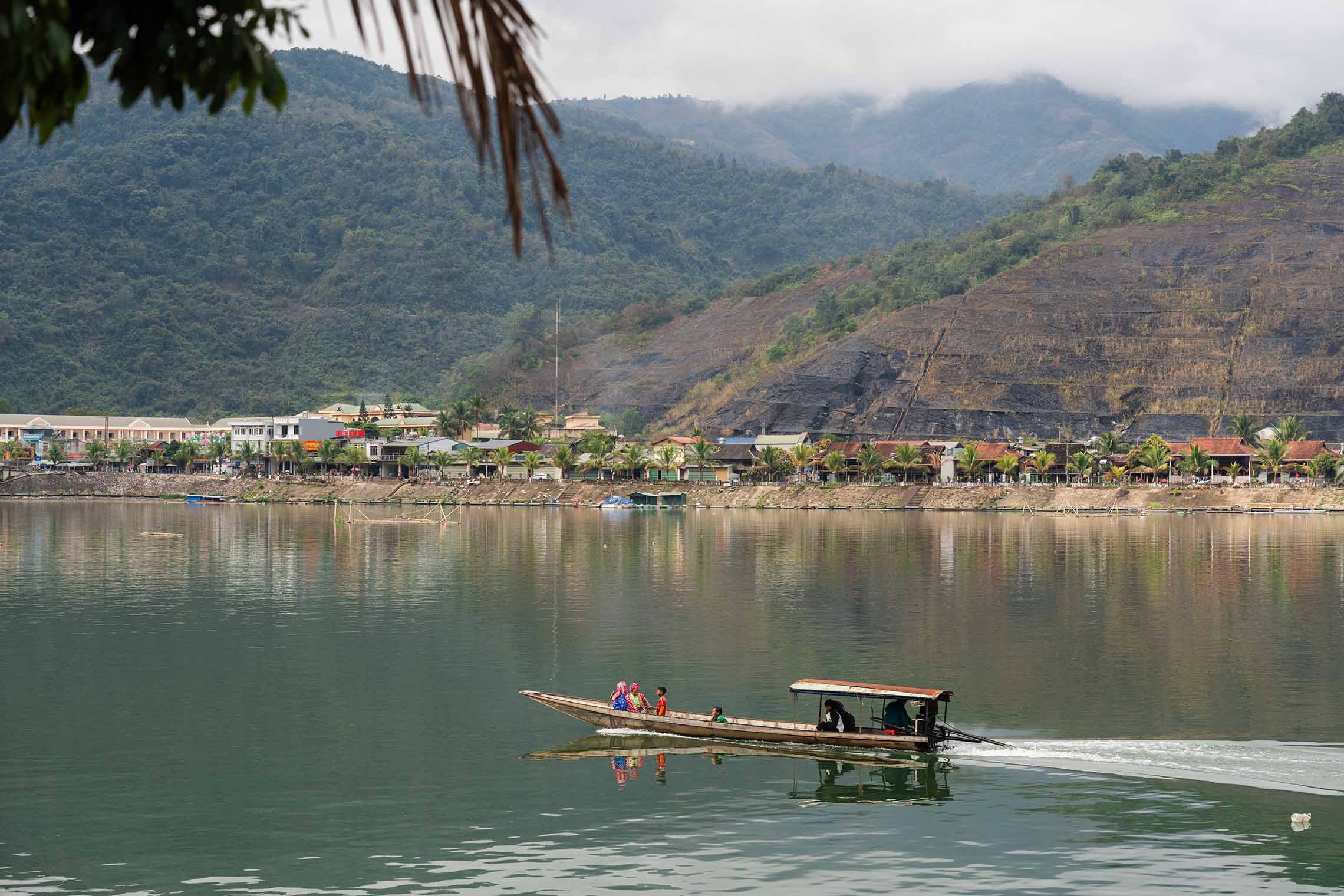
Du khách ngồi trên thuyền thưởng ngoạn cảnh sắc sông nước và núi rừng Điện Biên

Aerial view of a winding road through the mountainous landscape of Dien Bien

Quick information

Frequently Asked Questions

Travelers can consider hotels around major roads such as Vo Nguyen Giap, Truong Chinh and Him Lam. These areas provide convenient access to central attractions, with A1 Hill, the De Castries Bunker and the Dien Bien Phu Victory Museum within easy reach by taxi or on foot, while restaurants, cafés and local shops are also close by.

Accommodation can fill up quickly during major holidays, the Ban Flower season and the rice harvest. Booking one to two months ahead is recommended, followed by a quick confirmation with the property a few days before departure to make sure the reservation remains in place.

Most homestays in cultural villages can prepare traditional meals upon request, often using ingredients sourced locally. Dishes may feature hill chicken, stream fish, bamboo shoots and seasonal forest vegetables, giving travelers a chance to experience the flavors of Northwest Vietnamese cooking in a home-style setting.

Flavors, crafts and memories packed in Dien Bien souvenirs

In Dien Bien’s markets, a quick stop for local specialties can easily turn into the challenge of deciding what will fit in the suitcase. Faced with rows of flavours, handmade objects and small pieces of everyday craft, the choice also means deciding which memory deserves a place in the luggage. Some linger through taste, others through the texture of something made by hand, while a few recall a particular afternoon, a conversation or a fleeting moment in the mountains.

Take the distinctive Dien Bien souvenirs home

Dien Bien souvenirs encompass agricultural produce, traditional drinks and handmade goods shaped by the province's highland life.

What to buy in Dien Bien that carries the taste of the highlands

Dien Bien is known for mountain specialties whose names lead back to the places where they are grown, gathered or prepared, giving each food an identity rooted in its origin. Muong Phang Tan sticky rice, Seng Cu brown rice and three-colour brown rice come from fertile cultivation, while wild forest honey and Tua Chua tea belong to higher ground, where flowering seasons and old tea trees influence each harvest. In addition, Muong Ang Arabica coffee contributes a deep roasted aroma, whereas Son Tra (wild hawthorn) wine and Sau Chit wine, a prized Northwest tonic infused with protein rich larvae harvested from inside wild reed stems during late autumn and winter, draw on distinctive botanicals gathered across the highlands.

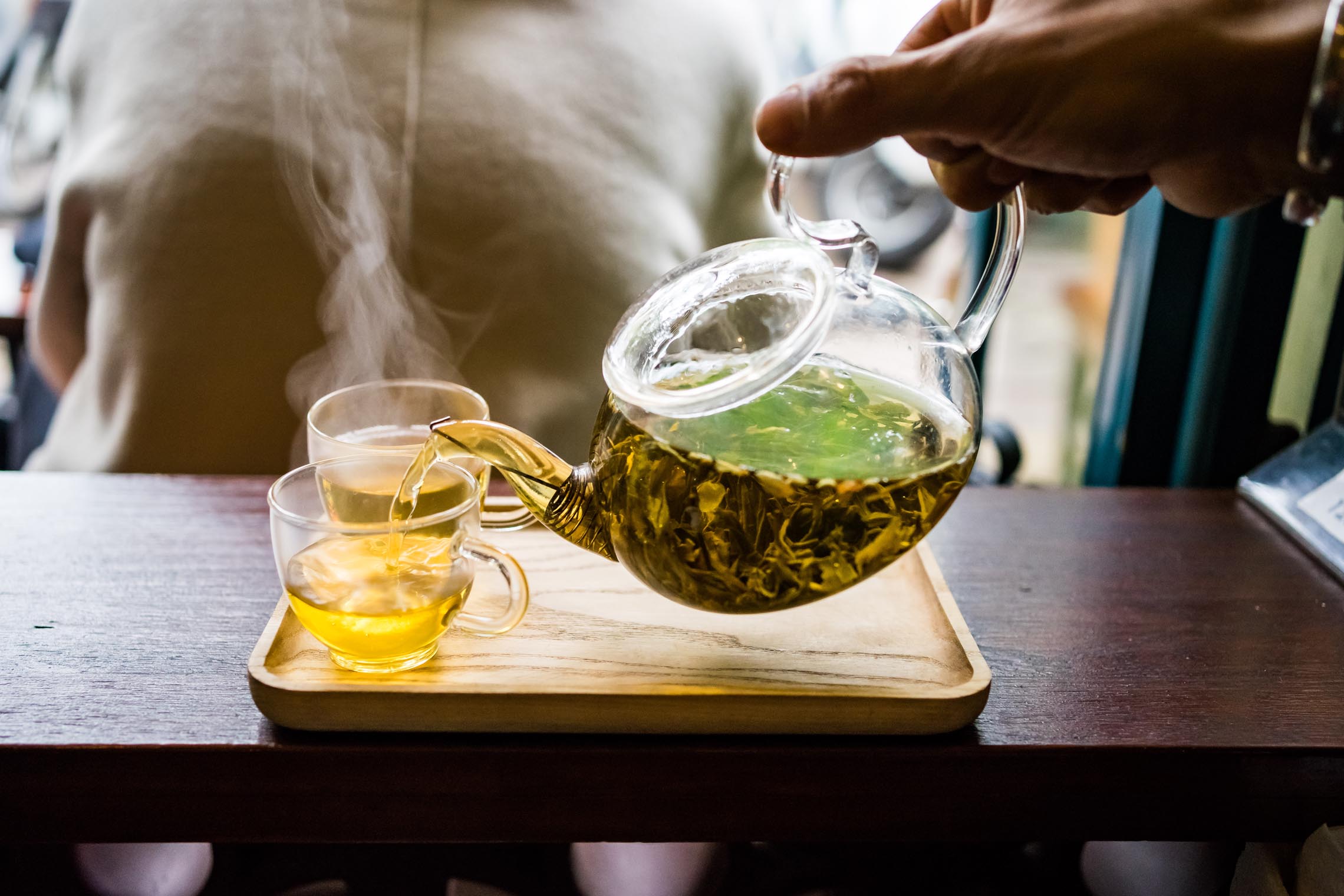
Thưởng thức trà Shan Tuyết pha nóng tại một quán nước

Serving Tua Chua tea, one of best known Dien Bien’s delicacies

At festive gatherings, food becomes part of the occasion itself, with certain preparations appearing when families mark important dates or welcome guests. Sticky rice occupies a prominent place at celebrations, while peanuts, preserved foods and cakes are arranged for sharing around the table. This connection between local produce and festive traditions is particularly evident in Khau Xen (Crispy rice and cassava cake) and Chi Chop (Sticky rice cakes) from Muong Lay, where grains and local ingredients become colourful, fragrant sweets, as well as in the use of Na Son red peanuts and Cha Nua peanuts for everyday snacking and seasonal celebrations.

Travel-friendly gifts from Dien Bien

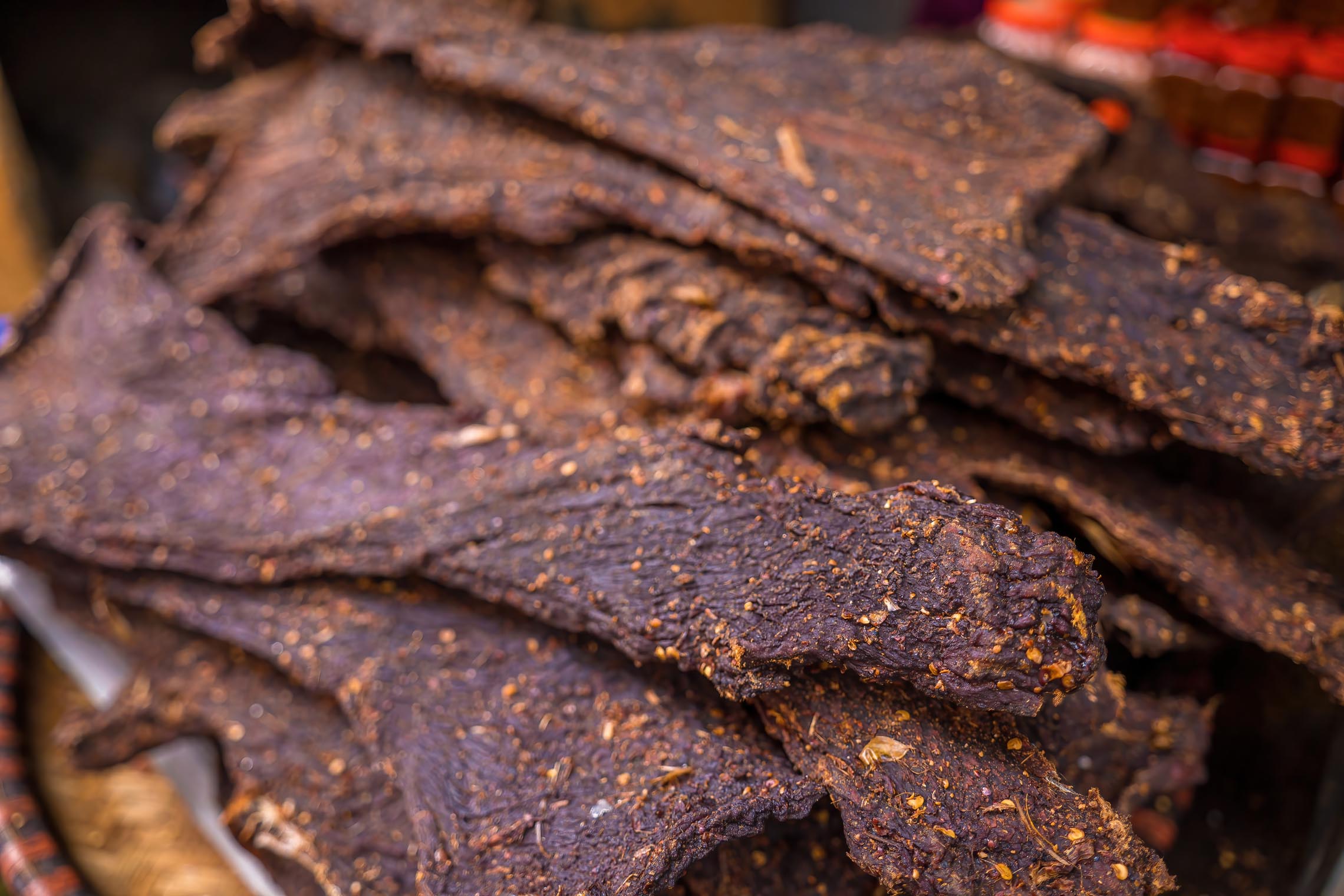
In the kitchens of Dien Bien's mountain households, the changing seasons have long dictated how food is gathered, prepared and preserved, with each method shaped by the need to make the harvest last and respect the labour behind it. Meat is suspended above the kitchen fire until smoke slowly darkens its surface and draws out moisture, bamboo shoots gathered from the forest are dried in the sun before being stored, while rice harvested from the fields is carefully kept for family meals, celebrations and occasions when guests arrive. Such practices grew from everyday life in the highlands, where preserving food meant making full use of what had been raised, cultivated or gathered through the year.

That heritage remains visible in the foods easiest to take home, particularly smoked buffalo meat and smoked sausage, whose savoury depth develops through careful curing, seasoning and hours above wood smoke, while dried bamboo shoots require patience as fresh shoots are cleaned, sliced and dried until their texture changes. Upland sticky rice belongs to another part of the agricultural cycle, its fragrance and soft grains appearing at celebrations and communal meals where rice signifies abundance and hospitality, while wild forest honey brings the perfume of flowering seasons into the household after being gathered from the surrounding forests.

Thịt trâu sau khi được hun khói bằng củi trong gian bếp

Smoked buffalo meat hanging over a wood fire in Dien Bien

Packaging matters when these foods are taken home, particularly by air, so secure wrapping and clear product information help protect the purchase, while asking sellers about storage or preparation adds useful context once an unfamiliar ingredient reaches the home kitchen.

Where to buy Dien Bien souvenirs 

In Dien Bien, shopping moves between carefully selected regional products and the unfiltered bustle of everyday commerce, with each setting lending a different context to what eventually goes into the luggage.

Specialty shops and cultural tourism spaces

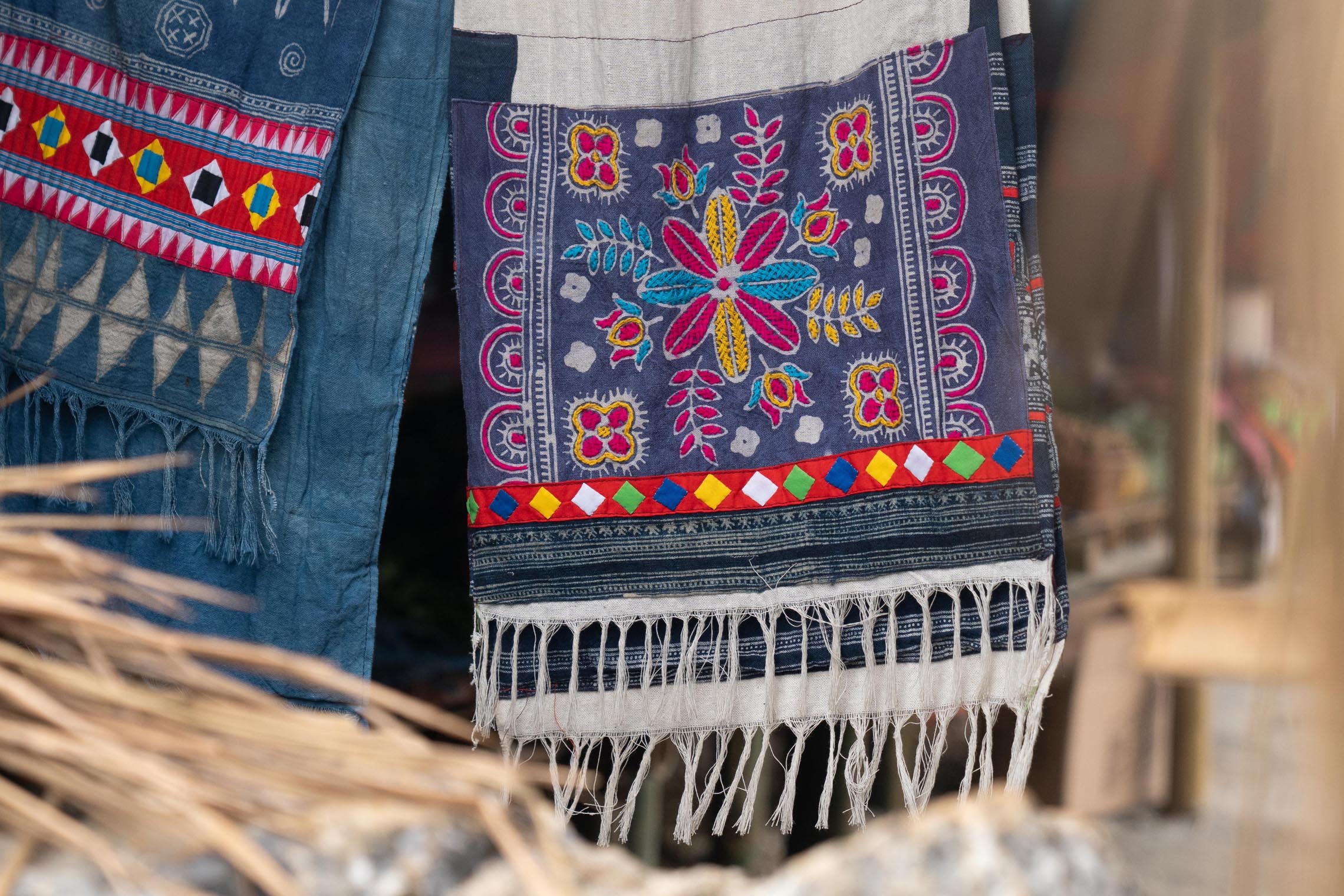
In Dien Bien Phu City, specialty shops and OCOP (short for One Commune One Product) stalls gather goods from across the province, yet the shelves can still evoke the terrain outside the city through the names, colours and materials attached to each product. Leaving behind the bustle of modern shop, the shopping atmosphere becomes more tactile in cultural-tourism villages, where shopping can take place beneath the timber eaves of a stilt house with rice fields stretching towards wooded slopes. In this distinctive shopping setting, fashion pieces in deep indigo cloth absorb the afternoon light, red embroidery brightens shaded interiors, and warm timber frames intricate handwork. Behind these colours and patterns are the traditions of Thai, Hmong, Dao and Ha Nhi communities, whose distinctive forms of ornament are closely woven into ceremonies, family life and the identity of each village.


Trang phục truyền thống của đồng bào các dân tộc Việt Nam

Vietnamese ethnic people wearing traditional costumes in Dien Bien

Historical places can give a purchase a stronger connection to the landscape just visited, since a hand-embroidered textile or silver ornament may recall ceremonial dress and craft practices that have survived alongside generations of change. A conversation with the seller can lead from the object itself to the materials used, the village where it was made and the occasions when it is worn or displayed, keeping the souvenir connected to the cultural life of the community rather than reducing it to a decorative keepsake.

Local markets for a more authentic shopping experience

The highland market follows the agricultural calendar rather than a fixed selection of souvenirs, with people arriving from surrounding villages as the season dictates what can be harvested, prepared or sold, so the scene shifts from one market day to another as baskets fill with produce and handmade goods while sunlight moves across canvas awnings and timber stalls.

Amid the morning bustle, the eye is drawn to flashes of deep indigo among embroidered sleeves, polished silver and bamboo baskets, with the sound of weighing scales, footsteps and voices rising through breakfast smoke scented with herbs and grilled food. Against the lively market scene, the indigo cloth stands out for its rich, earthy colour, appearing here and there among the stalls and catching the eye as shoppers move through the market.

The goods in Dien Bien’s local markets are rarely arranged with the precision of a showroom, yet that informality keeps them close to household routines and the hands that produced them, whether a textile made for family use or a basket still marked by years of practical work.

Shopping here can lead naturally into everyday cultural life, as a simple question about a pattern, bracelet or household object often opens a conversation about the ceremonies, clothing and customs associated with it. The changing selection also hints at the agricultural seasons and the movement between villages that keeps these market gatherings alive. With the hours passing, the lively market gradually begins to quieten, signalling the close of another day of trading and exchange. By dusk, as stalls empty and the last baskets disappear from the market floor, a small purchase can retain the colours, sounds and craftsmanship of the highlands, recalling not simply what was bought but the landscape and community surrounding it.


Quick information

Frequently Asked Questions

Travelers visiting Dien Bien in spring, from January to March, can look for fresh bitter bamboo shoots and Khau xen cakes. Fresh chít worms and newly harvested upland sticky rice are best sought from September to December, when the rice is particularly fragrant and seasonal products are more readily available.

Tua Chua snow tea and upland sticky rice are thoughtful choices for older family members, while smoked buffalo meat and smoked sausage work well as gifts for friends or colleagues. Chít worm wine is another option for gatherings, particularly when the gift is intended to be shared over a casual meal or drinks.

Smoked buffalo meat and smoked sausage should be vacuum-sealed and packed securely, ideally in a foam box sealed with tape. Liquid products such as chít worm wine and wild forest honey should be placed in sturdy plastic bottles, wrapped carefully with bubble wrap and packed in checked baggage to reduce the risk of leakage or breakage.

Offers from Vietnam Airlines

Promotion List
Sorry, there are currently no promo codes matching the selected criteria!
Please search again with different criteria
Filters

Loading