

Select region and language


Greening the Skies: Vietnam Airlines' Dual Journey
Starting from January 1, 2026, Vietnam officially participates in CORSIA – the global carbon offsetting and reduction scheme for international flights. This represents a significant milestone in the green transition roadmap of Vietnam's aviation industry, demonstrating its commitment to integrating with global sustainable development standards. Affirming its pioneering role as the National Flag Carrier, Vietnam Airlines is simultaneously driving digital transformation and green transition – a dual journey to prepare for deeper compliance starting in 2027.
What you need to know about CORSIA
CORSIA (Carbon Offsetting and Reduction Scheme for International Aviation) is a global scheme initiated by the International Civil Aviation Organization (ICAO) to control and offset CO₂ emissions from international flights. To prevent emissions from continuing to rise in tandem with air transport growth, CORSIA establishes a baseline emissions level and requires airlines to keep their total CO₂ emissions from exceeding this threshold.
Under the regulations, airlines must monitor, report, and independently verify (MRV) their annual emissions. If emissions exceed the baseline, the airline must offset the difference by purchasing carbon credits from internationally recognized emission reduction projects, or by using Sustainable Aviation Fuel (SAF) to reduce emissions directly at the source.
CORSIA is implemented by ICAO in three phases: a pilot phase (2021–2023), a voluntary first phase (2024–2026), and a second phase running from 2027 to 2035. Vietnam's official participation in CORSIA's voluntary phase starting in 2026 carries significant meaning: it demonstrates environmental responsibility while meeting strict, transparent international standards in emissions data management. Compliance with CORSIA is also one of the key criteria for assessing the reputation, quality, and integration capability of Vietnamese airlines on the international stage.
Vietnam Airlines' Preparation
Dưới đây là bản dịch chuẩn xác toàn bộ nội dung bạn đã cung cấp sang tiếng Anh theo đúng văn phong báo chí (Journalistic Style), đảm bảo sát nghĩa 100%, không thêm bớt chi tiết và có 1 space giữa các đoạn:
To proactively meet the requirements of CORSIA, Vietnam Airlines has been implementing comprehensive and systematic initiatives across two key pillars: digital transformation and green transition.
On the digital transformation pillar, Vietnam Airlines is focusing on enhancing operational capabilities, data governance, and customer experience through advanced technology platforms. Vietnam Airlines proactively collaborates with domestic and international technology partners to accelerate digital transformation, improve operational efficiency, and elevate service quality. Key areas of cooperation include artificial intelligence, cloud computing, big data, and digital platforms serving e-commerce, customer management, as well as internal operations. These new solutions help the carrier systematically standardize data, enhance inter-departmental coordination, elevate passenger experience, and establish the essential digital foundation for modern governance.
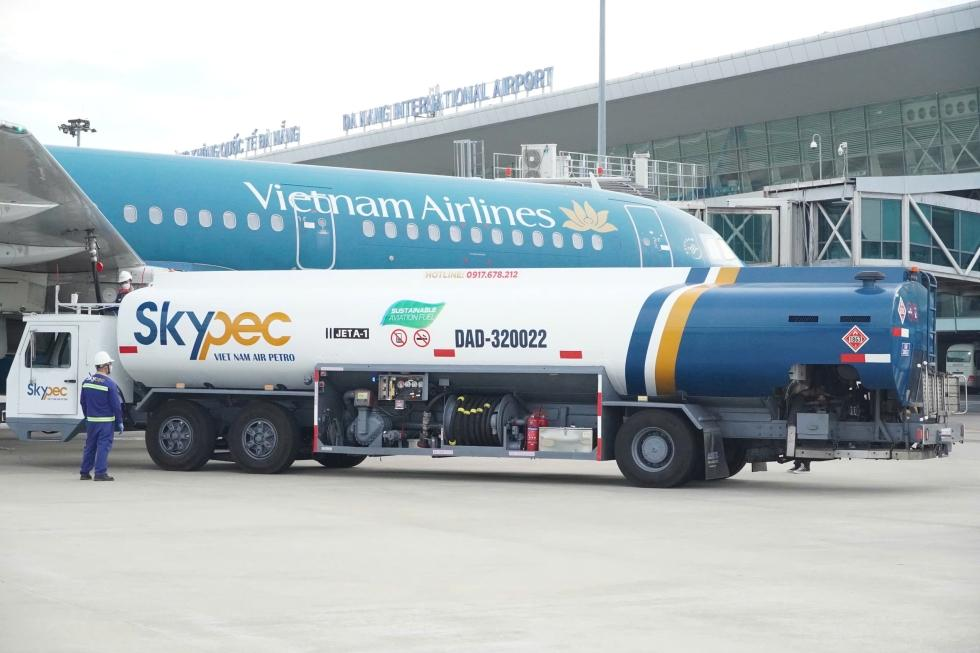
Regarding green transition, Vietnam Airlines is the first airline in Vietnam to operate a commercial flight using Sustainable Aviation Fuel (SAF). Flight VN660 from Singapore to Hanoi on May 27, 2024, launched a roadmap to reduce emissions directly at the source. From January 1, 2025, the carrier's flights departing from Europe began utilizing a minimum of 2% SAF, with plans to increase this to 6% by 2030, 20% by 2035, and 70% by 2050. In June 2025, Skypec refueled a 5% SAF blend for six of Vietnam Airlines' domestic flights departing from Da Nang to Hanoi and Ho Chi Minh City. In addition, a fleet featuring modern, environmentally friendly aircraft models such as the Boeing 787 and Airbus A350, along with flight route optimization programs, plastic waste reduction, and ground energy conservation, has also contributed to significantly reducing annual CO₂ emissions.
Challenges and Opportunities
Vietnam Airlines considers joining CORSIA not only a legal obligation but also a strategic opportunity to elevate its standing on the international stage. The convergence of digitalization and green transformation capabilities is creating a competitive advantage for the carrier as it enters the CORSIA implementation phase in its pioneering role as the National Flag Carrier. However, the path ahead also presents significant challenges. According to estimates by the Civil Aviation Authority of Vietnam (CAAV), in 2026, Vietnam Airlines may have to spend approximately 5.6 to 37.5 million USD to purchase carbon credits, depending on market prices fluctuating between 6 and 40 USD per credit.
In addition, the price of Sustainable Aviation Fuel (SAF) – a central element in the emission reduction roadmap – is currently 2 to 6 times higher than that of traditional jet fuel and meets only about 0.1% of global demand, significantly increasing operating costs for airlines.
However, the pressure from CORSIA also creates an opportunity for Vietnam Airlines to affirm its pioneering role and position by enhancing international reputation, expanding partnerships with global allies, and increasing competitiveness in markets with stringent emissions requirements such as Europe and North America. For the 2025–2030 period, the carrier aims to collaborate with international organizations, manufacturers, and technology corporations to research, test, and commercialize SAF, while leveraging domestic agricultural and forestry potential to develop carbon credit projects that meet international standards to serve its emissions offsetting needs.
With thorough preparation and an ambition to thrive, Vietnam Airlines is step-by-step meeting international standards, heading toward the Net Zero target by 2050, and contributing to bringing Vietnamese aviation closer to global green standards – where digital transformation and green transition go hand in hand, paving the way for a sustainable aviation future.
TIN LIÊN QUAN
Note:  Link opens in new window. Site may not meet accessibility guidelines.






© 2025 Vietnam Airlines JSC
Contact Center for calls within Vietnam (24/7): 1900 1100
For Lotusmiles members: 1900 1800
For calls from outside Vietnam (24/7): +84 24 38320320
Email: Telesales@vietnamairlines.com
Certificate of Business Registration - No.: 0100107518, Initial registration made on 30 June 2010, the 10th registration of changes made on 24 July 2025.




You are about to leave Vietnamairlines.com

You will be redirected to a website that is not owned by Vietnamairlines and is not within our control. The site may not follow the same accesibility polices as Vietnam Airlines.
Would you like to continue?
Would you like to continue?
Notice

According to regulations of the Ministry of Finance, E-VAT invoices are only issued for payment in VND. In case of paying by other currency, please change website country/region.